

Tony
September 11 – 15
September 11 – 15
Five Days Only
Fri Sept 11 – 3:30 & 7pm
Sat Sept 12 – 7pm
Sun Sept 13 – 1:30 & 7pm
Mon Sept 14 – 7pm
Tues Sept 15 – 7pm Final show
Biography / Comedy
Rated 14A – 1 hr 46 min
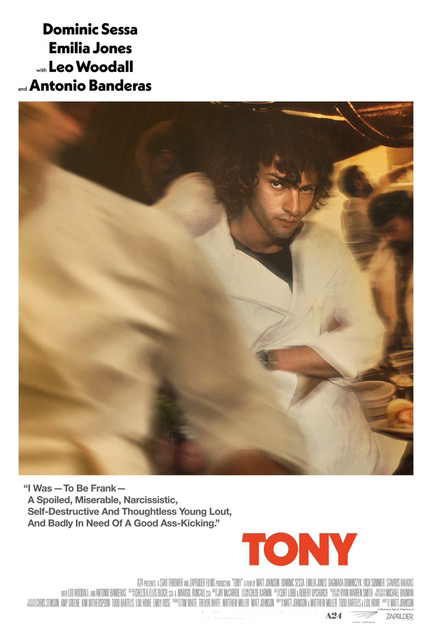
With Tony, his biopic about a transformative summer for a young Anthony Bourdain, Matt Johnson serves up a remarkable coming-of-age story. On paper, a biopic about Anthony Bourdain seems like a tall order. He was a singular figure. A chef who made an impact whilst running Brasserie Les Halles in Manhattan. A TV host whose travelogues took us to far corners of the globe. An author whose writing was frank, matter-of-fact and sharp. All this has given Bourdain, who died in 2018 after taking his own life, a vast and hallowed legacy. Contrastingly, the biopic is a genre with entrenched clichés and a tendency towards safe hagiography. Unless the right director came in, a film about Bourdain threatens to be so standard that it becomes unrepresentative of the man himself.
Enter Matt Johnson. The Canadian filmmaker has already had a great 2026 thanks to Nirvanna the Band the Show the Movie. Now he brings us Tony, a comedy-drama he has co-written with regular partner Matthew Miller (retooling an original story from Todd Bartels and Lou Howe). Johnson’s had success spicing up biographical projects before. 2023’s BlackBerry took a brand biopic about a phone and made it all about failure and hubris. And barring a few moments, Tony avoids the usual biopic tropes. It is a film with an edge, unafraid to portray its protagonist as an asshole, which rejects being broad in favour of focusing on one part of its subject’s life: One transformative summer in 1975.
The film opens with a quote from Bourdain describing his young self as “a spoiled, miserable, narcissistic, self-destructive and thoughtless young lout… badly in need of a good ass-kicking.” Aside from being a hell of a way to introduce your protagonist, this is also Johnson tipping his hand: The coming-of-age film that follows is both a meditation on each one of those adjectives, and an ass-kicking stretched out to feature length. It’s sincerely interested in who this lost 19-year-old thinks he is, who he actually is, and who he’s going to choose to become. What’s wonderful about Sessa’s performance is that Tony obviously isn’t the hotshot he pretends to be, but he’s also not all that good at pretending. It’s not so much that he thinks he’s great, but that, for whatever reason, he needs to believe that he is. That one distinction is how Sessa can embody all the epigraph’s unlikable traits and remain remarkably easy to root for. It’s delicate, involving work.
Tony walks a very fine line in showing its protagonist’s honesty, but it’s smart enough to show the factors that cause Bourdain to be so caustic. A brief glimpse into his family life reveals how expectations without acclaim gave him a misguided view of what success really looks like, and Johnson uses inventive stylistic techniques to show the narrowing of Bourdain’s reality.
Bourdain was a fairly harsh critic of Hollywood, and it’s easy to imagine that the idea of his life being turned into a film would repulse him. However, Johnson wasn’t necessarily making a film for Bourdain, but rather one that uses his life to reflect universal truths about the coming-of-age experience. If the biopic nature of the film was to be ignored, it’s easy to imagine that Bourdain and Johnson would be on the same wavelength.
Directed by:
Matt Johnson
Starring: