

qathet film society presents
3 Ears Indigenous Film Festival
təm kʷaθ nan NAMESAKE
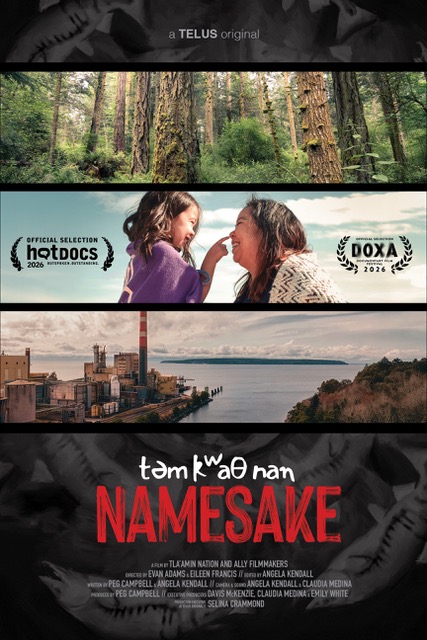
təm kʷaθ nan Namesake
Saturday September 26 – 1:30 pm
Wednesday September 30 – 7 pm
Directed by: ƛɛsla Dr. Evan Adams & t̓agəm Eileen Francis
Language: English & Ayajuthum
Genre: Documentary
Rated G – 1 hr 16 min
Released: 2026
Q&A with the film team to follow both screenings
Preceding the September 30 screening:
Doreen Point, Welcome prayer
Tla’amin Spirit Singers perform
Təm kʷaθ nan Namesake captures Tla’amin Nation’s push to reclaim the meaning of place. The documentary follows the Tla’amin Nation’s call for the City of Powell River to reconsider a name that honours Israel Wood Powell, a provincial official whose legacy is bound up with policies that caused lasting harm to the Tla’amin people, culture, and territory.
Powell served as British Columbia’s Superintendent of Indian Affairs for 17 years. He was a key figure in advancing violent colonial policy during a period when Indigenous Nations were being pushed off their lands, their governance systems undermined, and their children targeted through church- and state-run institutions. His name is linked to the expansion of the residential school system, the criminalization of ceremonies such as the potlatch, and the seizure of Indigenous territory, including Tla’amin land known as lot 450.
Seen in that light, the debate at the center of the documentary is not about a city trying to update its image. It’s about whether a community is willing to keep celebrating a figure connected to the deliberate harming of Indigenous peoples while asking those same communities to accept that legacy as normal and “get over it”.
The use of archival material and oral history isn’t treated as supplemental. It’s central to the film’s message. The documentary doesn’t present history as something distant or settled. It presents it as active, shaping the present moment in ways that are still being negotiated. That creates a constant tension between what is documented and what has been lived, especially when they don’t align. The result is a film that doesn’t just inform, it recalibrates how you interpret the information being presented.
Co-director Evan Adams describes the film as one that remains with those hard questions rather than sidestepping them. “This film sits in the tension between memory and responsibility,” Adams said. “It does not turn away from difficult truths, and it asks what it means to live well with each other in a place where we have different histories. It’s a story that will resonate in small towns facing Reconciliation across the country.”
The process has been a long one, and təm kʷaθ nan Namesake includes a beautiful and moving device for illustrating this. Sequences animated by multimedia artist Sterling Larose use the traditional 13-moon calendar of the Tla’amin People not only to mark the passage of time but also to illustrate how giving something a name is delicately interwoven with how we interact with a place.
The structure leans into accumulation rather than escalation. There’s no single turning point that defines the film. Instead, it builds through conversations, meetings, and personal reflections that gradually reshape your understanding of what’s at stake. That approach mirrors the real-world process it’s documenting. Change doesn’t happen in one moment; it happens through repeated engagement, disagreement, and persistence.
What makes təm kʷaθ nan Namesake stand out is how it handles the weight of the reality that it presents. It doesn’t push for a specific emotional response, and it doesn’t try to package its ideas into something easily digestible. It presents the reality of the situation as it exists, with all its complexity, discomfort, and urgency intact.
By the end, the title itself takes on a different meaning. It’s not just about what a place is called. It’s about who gets to carry that name forward, and what they choose to do with it once they understand what it represents. This isn’t a film that tells you what to think. It makes it harder to avoid thinking about it at all.
The film had its world premiere at Hot Docs in Toronto; and has screened at DOXA in Vancouver; and F1RST: A Celebration of Indigeneous Film, in Victoria. Future screenings include: Edmonton International Film Festival; Stseptékwles re Sk’elép (Coyote Stories) Indigenous Film Festival in Kamloops; Lunenberg Documentary Festival; Windsor International Film Festival; Calgary Justice Film Festival; Native Spirit Film Festival in the UK; and Red Nation International Film Festival in California.